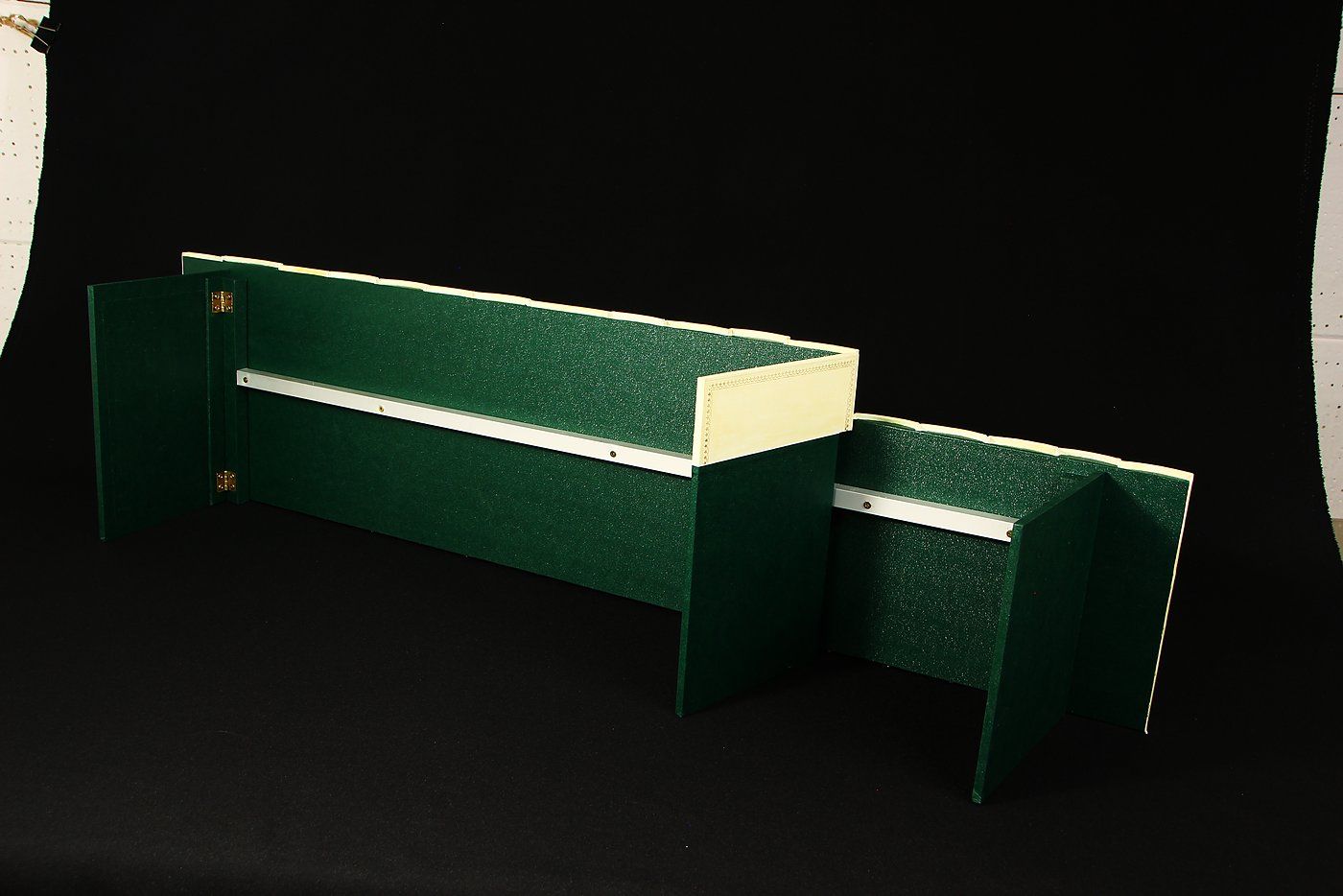
A hidden bookcase door is a door built as a working bookcase, so that it reads as part of a library wall until it swings open. The carpenter or door maker builds the door and its mechanism; the books on its shelves make it disappear. At Book Spines by Antykwariat Polski, a Warsaw antiquarian bookshop, we hand-make the leather spines for these doors, cut to each shelf and matched to the books around it. This guide covers the planning decisions that separate a convincing hidden door from a novelty.
Why start with the mechanism, not the books?
The most common mistake in early sketches is choosing the book styling before confirming how the door will move. Pivot hinges, concealed hinges and sliding tracks each set limits on weight, depth and the gaps around the frame. A pivot door needs hardware rated for the substrate plus the book facade; a sliding door needs track clearance resolved with the architect before the opening is framed. Fix the hardware first, then design the books to fit the resulting shelves.
Weight is where the books come in. Our spine panels weigh about 3.5 kg per running metre at 30 cm tall, much lighter than real books, which keeps the load on the hinges low. For hinge types, latches and frame details, read how a secret bookcase door is built.
How do you match the door to the rest of the library?
A hidden door only vanishes if it sits within shelving that already looks authentic. The spines on the door must carry the same binding style, spine width, lettering and slight irregularity as the fixed shelves beside it, right up to the seam. Uniform, machine-perfect spines draw the eye to exactly the wrong section of wall.
We recommend genuine leather for door panels rather than printed covers, because leather catches light like a real library and survives close inspection at handle height. Spines on panels suit most doors, especially sliding ones, as they are shallow and glued to the shelves. Where the shelves are deep and the hinges allow, 3D replicas add depth and shadow that read well when the door is seen at an angle.
Which details give a hidden door away?
- Shelf sag on the door: prevent it with bracing, not by relying on the books.
- The hinge gap: block sightlines with a dark-painted or felted return, never raw board.
- The release: a pull-book, touch-latch or lever must sit at a plausible height within the shelf composition.
- A showpiece door: resist filling it with only the finest spines. An ordinary mix, like the working shelves nearby, is more convincing.
Why plan the whole wall as one composition?
The door has to blend with its neighbours, so styling decisions cannot be made in isolation. Plan the real books, the decorative volumes and the door facade together from the start. Our checklist for library wall design gives a framework, and our hidden bookcase doors page shows how we work from your carpenter's drawing.
Frequently asked questions
Do you make the hidden bookcase door itself?
No. Book Spines by Antykwariat Polski makes the leather spines that face the door, to the drawing supplied. The door and its mechanism are built by your carpenter or door maker.
How heavy are book spines for a hidden door?
About 3.5 kg per running metre for a spine panel 30 cm tall, which keeps the load on hinges and tracks low.
How much do spines for a hidden bookcase door cost?
Every project is priced individually, depending on length, height, leather and tooling. The minimum order is 6 running metres, so the door is usually ordered together with the surrounding shelves.
Can you ship spines for a hidden door abroad?
Yes. Antykwariat Polski ships worldwide, including to the UK and the USA.
Written by Kamil Safulak, Antykwariat Polski: an antiquarian bookshop in Warsaw, with its own bindery and 25 years in the trade, whose leather binders hand-make the leather book spines described here.
Send us the size and the style you have in mind. We reply within 2 business days with a design and a price.
Made to order: faux book spine panels · custom faux books · faux library walls · hidden bookcase doors. Not sure yet? Order a sample of the leather and tooling first.