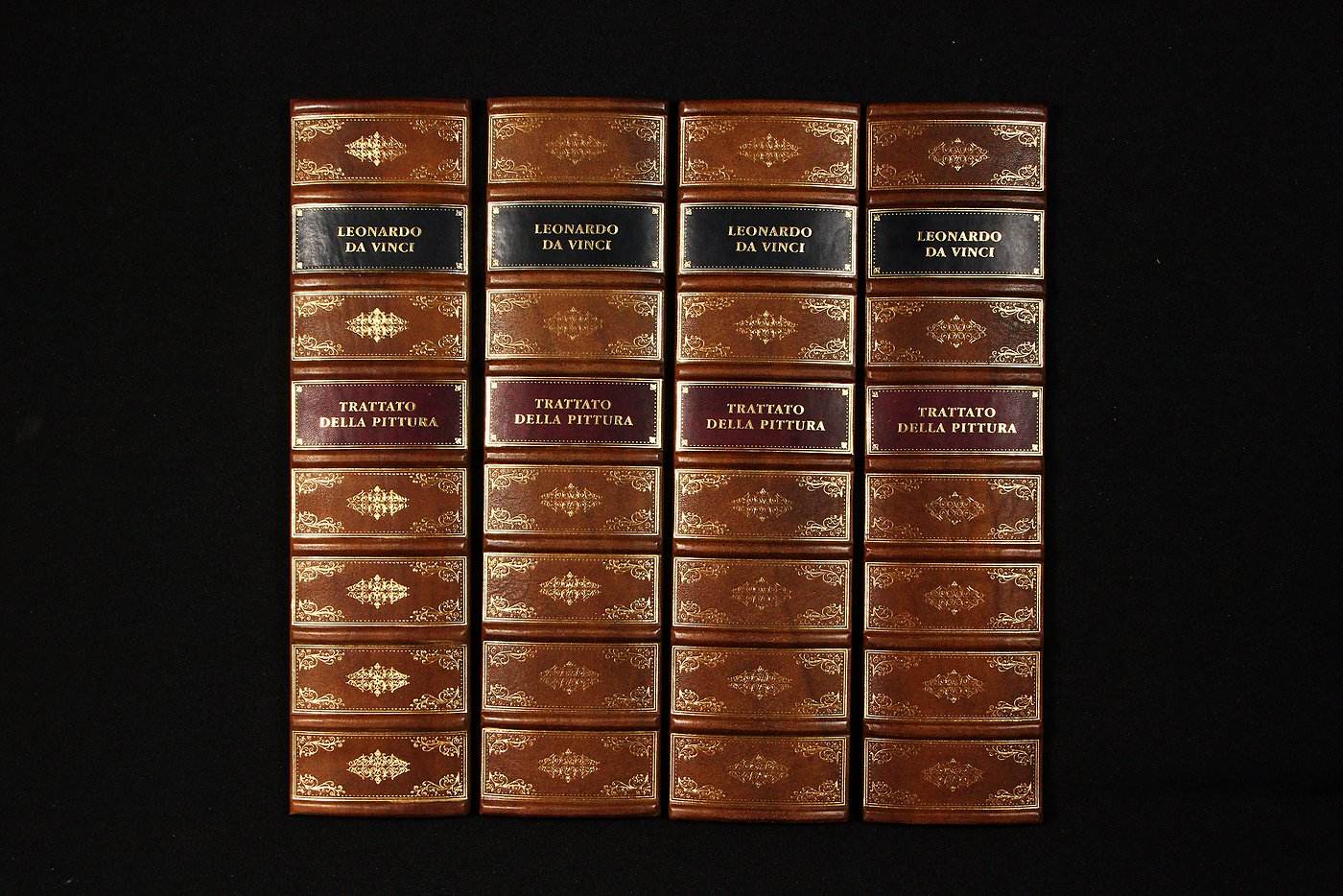
Restore a book when the book itself matters – its edition, provenance or place in a family collection. Choose faux antique books, meaning decorative leather replicas, when the aim is to fill shelving with the look of an old library at a predictable cost and on a fixed schedule. Antykwariat Polski, an antiquarian bookshop in Warsaw, does both: the team that binds and restores real books also hand-makes leather book replicas. These are the questions we hear most often.
What does antique book restoration involve?
Restoration is conservation. A bookbinder stabilises a genuine historical volume: rebacking a broken spine, consolidating dry leather, repairing torn pages, replacing missing endpapers with suitable materials. The aim is to preserve the object's authenticity and its market or sentimental value.
It is slow, specialised work, priced per volume, and it depends on the condition and rarity of each book. It is the right path when the books themselves are the point.
What are faux antique books?
Faux antique books are replicas of old leather bindings, made to dress a wall, a bookcase or a door rather than to be read. They come as spines on panels or as three-dimensional book boxes, and they are ordered by the running metre, not by the volume. A replica scheme is planned around the room: spine rhythm, heights, titles and the proportions of the shelving.
Ours are made in genuine, high-quality leather, hand-gilded and hand-embossed with the same techniques we use in bookbinding, so they read as old from arm's length and up close. You can see the range in our catalogue.
How do you choose between restoration and replicas?
Three factors usually decide it: the client's brief, the amount of shelving to fill, and whether real books already exist on site.
- A modest but genuine collection with historical or family weight should be restored and given the best place, even if it fills only a fraction of the shelves.
- A fully dressed library – a hotel lobby, a screening room, a hidden bookcase door, a show flat – almost always calls for replicas, for budget predictability and consistency across hundreds of spines.
- Many projects use both: restored heirlooms at eye level, replicas filling the remaining bays.
Our checklist for library wall design shows how to combine the two.
Do replicas look convincing next to real antique books?
They should, if they are made properly. The tell-tale sign of a poor replica is uniformity: identical heights, repeating patterns, printed textures that go flat under raking light. A well-made leather spine varies in height and detail and has real grain. We compare the materials in leather book spines vs printed panels.
How do cost and lead time compare?
Restoration timelines are unpredictable by nature: a binder cannot promise how an old binding will behave until the work is under way. Replica production runs to a specification and a schedule. Every project is priced individually, and we make up to 50 running metres in 20 working days – which matters for projects with fixed installation dates.
Is there a wrong answer?
Only if the choice is made without asking what the shelving is for. Restoration serves memory and authenticity; replicas serve architecture and atmosphere. Name that distinction at the brief stage and you save both budget and disappointment.
Frequently asked questions
What is the difference between book restoration and faux antique books?
Restoration conserves a genuine old book and preserves its value. Faux antique books are new decorative replicas, such as leather spines on panels or 3D book boxes, made to give shelving the look of an old library.
Are faux antique books made of real leather?
Those made by Antykwariat Polski are. The spines are genuine, high-quality leather, hand-gilded and hand-embossed by the same team that does the shop's bookbinding and restoration.
Can restored books and replicas share one shelf?
Yes, and many libraries do exactly that. Put the restored books where they can be seen and handled, and let replicas fill the upper or less accessible bays.
How long does it take to make decorative book replicas?
Antykwariat Polski makes up to 50 running metres in about 20 working days. The minimum order is 6 running metres.
Written by Kamil Safulak, Antykwariat Polski: an antiquarian bookshop in Warsaw, with its own bindery and 25 years in the trade, whose leather binders hand-make the leather book spines described here.
Send us the size and the style you have in mind. We reply within 2 business days with a design and a price.
Made to order: faux book spine panels · custom faux books · faux library walls · hidden bookcase doors. Not sure yet? Order a sample of the leather and tooling first.